1-35
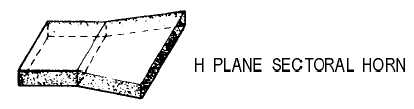
Figure 1-44B.—Waveguide horns. H PLANE SECTORAL HORN.
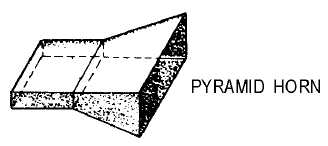
Figure 1-44C.—Waveguide horns. PYRAMID HORN.
As you may have noticed, horns are really simple antennas. They have several advantages over other
impedance-matching devices, such as their large bandwidth and simple construction. The use of horns as
antennas will be discussed further in chapter 3.
A waveguide may also be terminated in a resistive load that is matched to the characteristic
impedance of the waveguide. The resistive load is most often called a DUMMY LOAD, because its only
purpose is to absorb all the energy in a waveguide without causing standing waves.
There is no place on a waveguide to connect a fixed termination resistor; therefore, several special
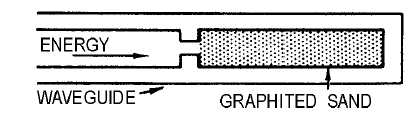
arrangements are used to terminate waveguides. One method is to fill the end of the waveguide with a
graphite and sand mixture, as illustrated in figure 1-45A. When the fields enter the mixture, they induce a
current flow in the mixture which dissipates the energy as heat. Another method figure 1-45B is to use a
high-resistance rod placed at the center of the E field. The E field causes current to flow in the rod, and
the high resistance of the rod dissipates the energy as a power loss, again in the form of heat.
Figure 1-45A.—Terminating waveguides.