1-32
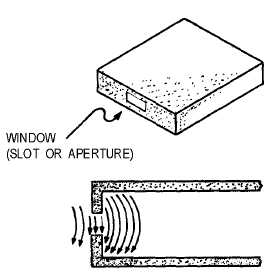
Slots or apertures are sometimes used when very loose (inefficient) coupling is desired, as shown in
figure 1-41. In this method energy enters through a small slot in the waveguide and the E field expands
into the waveguide. The E lines expand first across the slot and then across the interior of the waveguide.
Minimum reflections occur when energy is injected or removed if the size of the slot is properly
proportioned to the frequency of the energy.
Figure 1-41.—Slot coupling in a waveguide.
After learning how energy is coupled into and out of a waveguide with slots, you might think that
leaving the end open is the most simple way of injecting or removing energy in a waveguide. This is not
the case, however, because when energy leaves a waveguide, fields form around the end of the
waveguide. These fields cause an impedance mismatch which, in turn, causes the development of
standing waves and a drastic loss in efficiency. Various methods of impedance matching and terminating
waveguides will be covered in the next section.
Q-24. What term is used to identify each of the many field configurations that can exist in waveguides?
Q-25. What field configuration is easiest to produce in a given waveguide?
Q-26. How is the cutoff wavelength of a circular waveguide figured?
Q-27. The field arrangements in waveguides are divided into what two categories to describe the
various modes of operation?
Q-28. The electric field is perpendicular to the "a" dimension of a waveguide in what mode?
Q-29. The number of half-wave patterns in the "b" dimension of rectangular waveguides is indicated by
which of the two descriptive subscripts?
Q-30. Which subscript, in circular waveguide classification, indicates the number of full-wave patterns
around the circumference?
Q-31. What determines the frequency, bandwidth, and power-handling capability of a waveguide
probe?