3-39
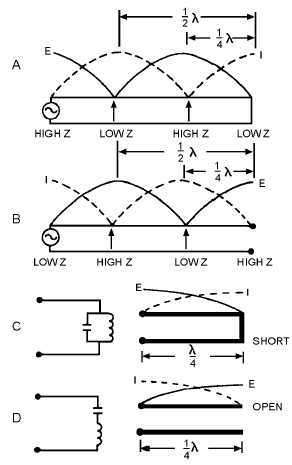
Figure 3-31.—Sending-end impedance of various lengths and terminations.
At all even numbered quarter-wavelength points from the short circuit, the impedance is extremely
low. When the frequency of the voltage applied to the line is varied, the impedance at these points
increases just as the impedance of a series-resonant circuit varies when the frequency applied to it is
changed. The same is true for an open-ended line (figure 3-31, view B) except that the points of high and
low impedance are reversed.
At this point let us review some of the characteristics of resonant circuits so we can see how resonant
line sections may be used in place of LC circuits.
A PARALLEL-RESONANT circuit has the following characteristics:
At resonance the impedance appears as a very high resistance. A loss-free circuit has infinite
impedance (an open circuit). Other than at resonance, the impedance decreases rapidly.
If the circuit is resonant at a point above the generator frequency (the generator frequency is too
low), more current flows through the coil than through the capacitor. This happens because XL
decreases with a decrease in frequency but XC increases.
A SERIES-RESONANT circuit has these characteristics: