1-20
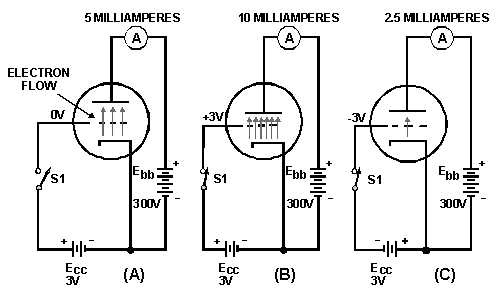
Figure 1-15.—DeForest's experiment.
In view (B), you see De Forest’s tube with +3 volts applied to the control grid. When De Forest
applied this voltage, he found that plate current, Ip, increased by a large amount. (We’ll say it doubled to
simplify the explanation.) You already know that the only way to double the plate current in a diode is to
increase the plate voltage by a large amount. Yet, De Forest had doubled plate current by applying only 3
volts positive to the control grid!
The reason for this is fairly easy to understand. It’s the old principle of "opposites attract." When the
control grid was made positive, electrons surrounding the cathode (negative charges) were attracted to the
grid. But remember, the grid is a metal mesh. Most of the electrons, instead of striking the grid wires,
were propelled through the holes in the mesh. Once they had passed the grid, they were attracted to the
positive charge in the plate.
You might wonder why the grid would make that much difference. After all, the plate has 300 volts
on it, while the grid only has 3 volts on it. Surely the plate would have a greater effect on current flow
than a grid with only one one-hundredth the attractive potential of the plate. But remember, in your study
of capacitors you discovered that opposites attract because of electrostatic lines of force, and that the
strength of electrostatic lines of force decreased with distance. In his tube, DeForest had placed the grid
very close to the cathode. Therefore, it had a greater effect on current flow from the cathode than did the
plate, which was placed at a much greater distance from the cathode. For this reason, De Forest was able
to double the current flow through the tube with only +3 volts applied to the grid.
DeForest had certainly hit on something. Now the problem was to find out what would happen when
a negative potential was applied to the grid. This is shown in view (C) of figure 1-15. When De Forest
applied -3 volts to the grid, he found that plate current decreased to half of what it was when the grid had
no voltage applied. The reason for this is found in the principle of "likes repel." The negatively charged
grid simply repelled some of the electrons back toward the cathode. In this manner, the attractive effect of
the plate was decreased, and less current flowed to the plate.
Now De Forest was getting somewhere. Using his new tube (which he called a triode because it had
3 elements in it), he was able to control relatively large changes of current with very small voltages. But!
was it amplification? Remember, amplification is the process of taking a small signal and increasing its
amplitude. In De Forest’s circuit, the small input signal was 3 volts dc. What De Forest got for an output