1-14
The plate voltage-plate current characteristic for a given diode is a measure of exactly how much plate
voltage controls how much plate current. This is often called the Ep - Ip characteristic.
The Ep - Ip characteristic for a given diode, is determined by design engineers using mathematical
analysis and laboratory experiment. You, as a technician, will never need to do this. However, you will
use the results obtained by the engineers. You will also use your knowledge of the diode as you analyze
equipment malfunction.
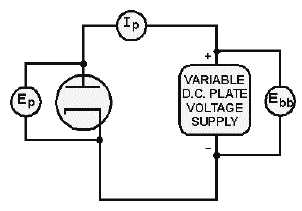
Assume that we have the circuit in figure 1-12. (The filament has the proper voltage-even though it
isn’t shown on the diagram.) Our purpose is to determine just how a changing voltage on the plate
changes (or controls) the plate current. The method is as follows:
Figure 1-12.—Determining diode plate characteristic.
1. Starting with zero volts from our variable dc voltage source, increase the plate voltage (Ep) in
steps of 50 volts until you reach 400 volts.
2. At a each 50-volt step, measure the milliamperes of plate current (Ip) that flow through the meter.
Record the Ip meter readings, step by step, so that you may analyze the results.
Assume that table 1-2 shows our results. While we could use the table, a more normal procedure is to
plot a graph of the values. Such a graph is called an Ep - Ip CURVE and is shown in figure 1-13. Each
tube has its own Ep - Ip curve, which is available in commercial tube manuals and in many equipment
technical manuals. Each curve will be different in some respects from every other curve. The shapes,
however, will be similar.
Ep
0
50
100
150
200
250
300
350
400
Ip
0
.002
.005
.010
.020
.030
.040
.042
.045
Table 1-2.—Ep - Ip Values Obtained by Experiment