3-18
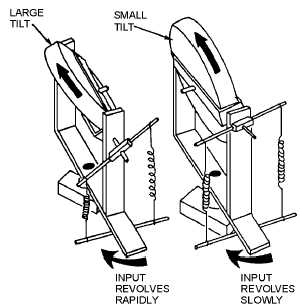
A. In this situation the gyro will precess twice as far before the tension on the restraining spring equals the
pull on the crossarm. Precession increases when the rate of rotation increases, as shown in figure 3-16.
Figure 3-16.—Precession is proportional to the rate of rotation.
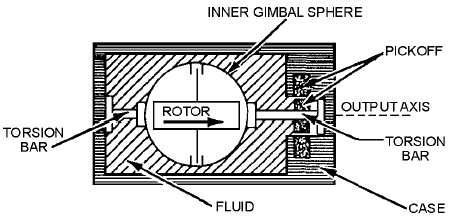
Another type of rate gyro (often used in inertial navigation equipment) is the floated gyro unit. This
unit generally uses a restraint known as a torsion bar. The advantage of the torsion bar over the spring is
that the torsion bar needs no lever arm to exert torque. The torsion bar is mounted along the output axis
(fig. 3-17), and produces restraining torque in either direction by twisting instead of pulling. Also, there is
no gimbal bearing friction to cause interference with gyro operation.
Figure 3-17.—Torsion bar-restrained floated rate gyro.
A fluid surrounds the gyro sphere and provides flotation. It also provides protection from shock, and
damps the oscillations resulting from sudden changes in the angular rate input. In this gyro, the inner
gimbal displacement must be measured with some type of electrical pickoff. As the gyro case is rotated
about the input axis, clockwise or counterclockwise, a precession torque will be developed about the