1-34
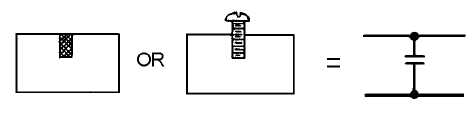
Figure 1-43A.—Conducting posts and screws. PENETRATING.
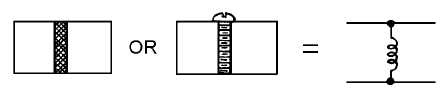
Figure 1-43B.—Conducting posts and screws. EXTENDING THROUGH.
Q-33. What is the result of an impedance mismatch in a waveguide?
Q-34. What is used to construct irises?
Q-35. An iris placed along the "b" dimension wall produces what kind of reactance?
Q-36. How will an iris that has portions along both the "a" and "b" dimension walls act at the resonant
frequency?
Waveguide Terminations
Electromagnetic energy is often passed through a waveguide to transfer the energy from a source
into space. As previously mentioned, the impedance of a waveguide does not match the impedance of
space, and without proper impedance matching, standing waves cause a large decrease in the efficiency of
the waveguide.
Any abrupt change in impedance causes standing waves, but when the change in impedance at the
end of a waveguide is gradual, almost no standing waves are formed. Gradual changes in impedance can
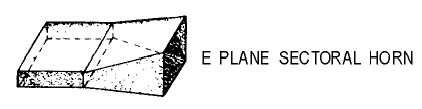
be obtained by terminating the waveguide with a funnel-shaped HORN, such as the three types illustrated
in figures 1-44A, 1-44B, and 1-44C. The type of horn used depends upon the frequency and the desired
radiation pattern.
Figure 1-44A.—Waveguide horns. E PLANE SECTORAL HORN.