2-43
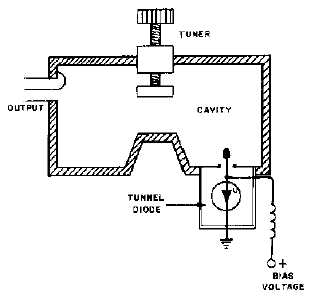
Figure 2-40.—Tunnel-diode oscillator.
The output power produced is in the range of a few hundred microwatts, sufficient for many
microwave applications. The frequency at which the oscillator operates is determined by the physical
positioning of the tuner screw in the cavity. Changing the output frequency by this method is called
MECHANICAL TUNING. In addition to mechanical tuning, tunnel-diode oscillators may be tuned
electronically. One method is called BIAS TUNING and involves nothing more than changing the bias
voltage to change the bias point on the characteristic curve of the tunnel-diode. Another method is called
VARACTOR TUNING and requires the addition of a varactor to the basic circuit. Varactors were
discussed in NEETS, Module 7, Introduction to Solid-State Devices, and Power Supplies, Chapter 3.
Tuning is achieved by changing the voltage applied across the varactor which alters the capacitance of the
tuned circuit.
TUNNEL-DIODE AMPLIFIERS.—Low-noise, tunnel-diode amplifiers represent an important
microwave application of tunnel diodes. Tunnel-diode amplifiers with frequencies up to 85 gigahertz have
been built in waveguides, coaxial lines, and transmission lines. The low-noise generation, gain ratios of
up to 30 dB, high reliability, and light weight make these amplifiers ideal for use as the first stage of
amplification in communications and radar receivers.
Most microwave tunnel-diode amplifiers are REFLECTION-TYPE, CIRCULATOR-COUPLED
AMPLIFIERS. As in oscillators, the tunnel diode is biased to the center point of its negative-resistance
region, but a CIRCULATOR replaces the tuned cavity.
A circulator is a waveguide device that allows energy to travel in one direction only, as shown in
figure 2-41. The tunnel diode in figure 2-41 is connected across a tuned-input circuit. This arrangement
normally produces feedback that causes oscillations if the feedback is allowed to reflect back to the tuned-
input circuit. The feedback is prevented because the circulator carries all excess energy to the absorptive
load (R
L). In this configuration the tunnel diode cannot oscillate, but will amplify.