4-45
for reception. The reduction of back radiation is perhaps of lesser importance for transmission. When an
antenna is terminated with resistance, the energy that would be radiated backward is absorbed in the
resistor.
Q47. What is the main disadvantage of the rhombic antenna?
TURNSTILE ANTENNA
The TURNSTILE ANTENNA is one of the many types that has been developed primarily for
omnidirectional vhf communications. The basic turnstile consists of two horizontal half-wave antennas
mounted at right angles to each other in the same horizontal plane. When these two antennas are excited
with equal currents 90 degrees out of phase, the typical figure-eight patterns of the two antennas merge to
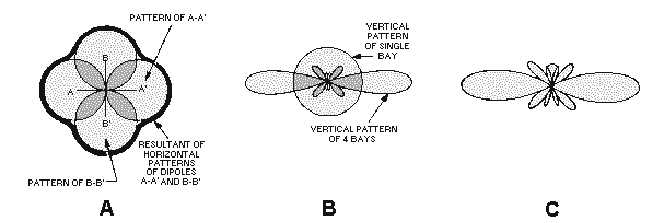
produce the nearly circular pattern shown in figure 4-39, view A. Pairs of such antennas are frequently
stacked, as shown in figure 4-40. Each pair is called a BAY. In figure 4-40 two bays are used and are
spaced 1/2 wavelength apart, and the corresponding elements are excited in phase. These conditions cause
a part of the vertical radiation from each bay to cancel that of the other bay. This results in a decrease in
energy radiated at high vertical angles and increases the energy radiated in the horizontal plane. Stacking
a number of bays can alter the vertical radiation pattern, causing a substantial gain in a horizontal
direction without altering the overall horizontal directivity pattern. Figure 4-39, view B, compares the
circular vertical radiation pattern of a single-bay turnstile with the sharp pattern of a four-bay turnstile
array. A three-dimensional radiation pattern of a four-bay turnstile antenna is shown in figure 4-39, view
C.
Figure 4-39.—Turnstile antenna radiation pattern.