2-30
Q26.
Define thermal inertia.
Q27.
Why are small-wattage soldering irons not used to solder large conductors?
Q28.
State why a well-designed soldering iron is self-regulating.
Q29.
What should be done to a soldering iron tip that is pitted?
Soldering Gun
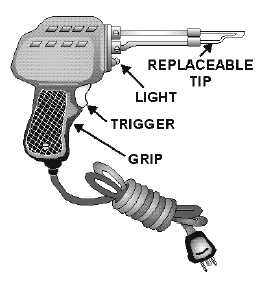
The soldering gun (figure 2-31) has gained great popularity in recent years because it heats and cools
rapidly. It is especially well adapted to maintenance and troubleshooting work where only a small part of
the technician's time is spent actually soldering.
Figure 2-31.—Soldering gun.
A transformer in the soldering gun supplies approximately 1 volt at high current to a loop of copper,
which acts as the soldering tip. It heats to soldering temperature in 3 to 5 seconds. However, it may
overheat to the point of incandescence if left on over 30 seconds. This should be avoided because excess
heat will burn the insulation off the wiring. The gun is operated by a finger switch. The gun heats only
while the switch is pressed.
Since the gun normally operates only for short periods at a time, it is comparatively easy to keep
clean and well tinned. Short operating time allows little oxidation to form. Because the tip is made of pure
copper, it is likely to pit, due to the dissolving action of the solder.
The gun or iron should always be kept tinned to permit proper heat transfer to the connection to be
soldered. Tinning also helps control the heat to prevent solder buildup on the tip. This control reduces the
chance of the solder spilling over to nearby components and causing short circuits. Maintaining the proper
tinning on the iron or gun, however, may be made easier by tinning with silver solder (a composition of
silver, copper, and zinc). The temperature at which the bond is formed between the copper tip and the
silver solder is much higher than with lead-tin solder. This tends to decrease the pitting action of the
solder on the copper tip.