5-29
Q-10.
What is the purpose of swept-frequency testing?
TRACKING GENERATOR
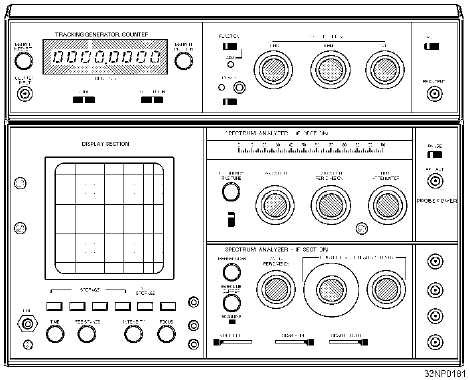
Figure 5-30 shows a typical tracking generator used with the Hewlett-Packard 141 T spectrum
analyzer. A TRACKING GENERATOR is basically a sweep generator in which the sweep rate is
matched to that of the spectrum analyzer. The output circuitry of the tracking generator contains a
network that ensures a constant output amplitude over the entire range being swept. When the fm signal
produced by the tracking generator is applied to a device or circuit under test, the instantaneous output
amplitude is always proportional to the response of the circuit to the frequency at that instant. Thus, the
original fm input signal is changed in passing through the circuit under test. The output signal, therefore,
would consist of an fm signal that is also amplitude-modulated. For equal deviations, the positive and
negative portions of this envelope are symmetrical, making it necessary to observe only one side of the
envelope. After the detection stage in the spectrum analyzer, only the modulation remains to appear on
the face of the crt. This presentation will appear as a continuous curve because of the persistence of vision
and the phosphor characteristic of the crt. The polarity of the detector determines whether a positive or a
negative output is displayed. The frequency at any point on the crt display can be analyzed by arresting
the scan of the spectrum analyzer either electronically or manually at the point of interest. For greater
accuracy in frequency determination, a frequency counter may be attached to the output of the tracking
generator at the point of the arrested scan.
Figure 5-30.—Tracking generator used with a spectrum analyzer.
IMPEDANCE MATCHING
Conventional tuners cannot be used successfully to cancel source or load reflections in swept-
frequency measurements. This is because the tuning is effective only at single frequencies; therefore, pads