2-18
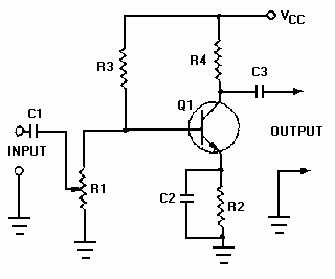
Figure 2-14.—Typical manual gain/volume control.
Automatic Gain/Volume Control (agc/avc)
Output volume variations of a receiver often result from variations in the input signal strength.
Changes in input signal strength occur when we change stations or when we experience fading because of
changing atmospheric conditions. The function of an AUTOMATIC GAIN CONTROL, also referred to
as an AUTOMATIC VOLUME CONTROL, is to limit unwanted variations in the output of the receiver
caused by variations in strength of the received signal input. A receiver without agc would require
continuous manual readjustment to compensate for received signal changes so that it could maintain a
constant output level.
Signals from stations operating at the same power level may not reach the receiver antenna with the
same power. This is because of differences in transmission distances, carrier frequencies, atmospheric
conditions, and obstructions between the transmitter and receiver antennas.
You might draw the conclusion that an agc network is not necessary when the receiver is operating
on a single station. However, this is not true; atmospheric conditions may cause the signal strength to vary
(fade in and out), or the antenna may receive components of the signal which have traveled along
different paths. For example, one component may travel directly from the antenna, and another may have
been reflected from a distant object. The two signals will sometimes be in phase and at other times be out
of phase, thus tending to reinforce or cancel each other. The result is a variation in signal strength at the
receiver antenna. This variation in signal strength is often referred to as FADING. The effect of fading in
the output signal voltage of an rf stage is best demonstrated by the following example: An rf amplifier
connected to a receiving antenna has a voltage gain of 100. If the antenna receives an input signal of 10
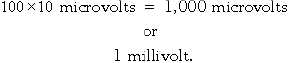
microvolts, the output voltage is computed as follows:
With the output voltage equal to 1 millivolt, and if fading is to be avoided, the output voltage must
remain at 1 millivolt. However, if a reflected signal is received that is approximately one-half the strength
(5 microvolts) of the original and is in phase with the original signal, the total input signal to the receiving