3-10
The formula for determining the resistance of the shunt is given by Rs = Im /Is times Rm, where Rs is
the shunt resistance in ohms; Im is the meter current at full-scale deflection; Is is the shunt current at full-
scale deflection; and Rm is the resistance of the meter coil. If the values given in the previous example are
used in this equation, it will yield 5.55 ohms, the value previously calculated.
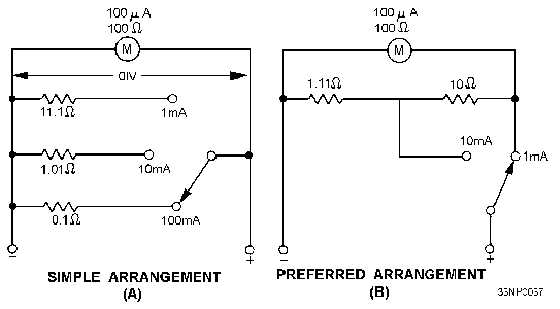
SWITCHING SHUNT VALUES.—Various values of shunt resistance can be used, by means of a
suitable switching arrangement, to increase the number of current ranges that can be covered by the
meter. Two switching arrangements are shown in figure 3-5. View A is the simpler of the two
arrangements when a number of shunts are used to calculate the values of the shunt resistors. However, it
has two disadvantages:
Figure 3-5.—Ways of connecting internal meter shunts.
1. When the switch is moved from one shunt resistor to another, the shunt is momentarily removed
from the meter. The line current then flows through the meter coil. Even a momentary surge of
current could easily damage the coil.
2. The contact resistance (resistance between the blades of the switch when they are in contact) is in
series with the shunt, but not with the meter coil. In shunts that must pass high currents, this
contact resistance becomes an appreciable part of the total shunt resistance. Because the contact
resistance is of a variable nature, the ammeter indication may not be accurate.
The generally preferred method of range switching is shown in (figure 3-5, view B). Although only
two ranges are shown, as many ranges as needed can be used. In this type of circuit, the contact resistance
of the range-selector switch is external to the shunt and meter in each range position. The contact
resistance in this case has no effect on the accuracy of the current measurement.
Ammeter Connections
When you are using ammeters, a primary rule of safety is that such current-measuring instruments
must always be connected in series with a circuit, never in parallel with it. When an ammeter is
connected across a constant-potential source of appreciable voltage, the low internal resistance of the
meter bypasses the circuit resistance. This results in the application of the source voltage (or a good