3-8
a full-scale deflection of the pointer would rest on the 150th division mark, indicating that 150 amperes of
load current is flowing. At half-scale deflection, the pointer would rest on the 75th division mark,
indicating that 75 amperes of load current is flowing.
A shunt having exactly the same current rating as the expected normal load current should never be
selected. If you were to select such a shunt, higher than normal load currents could possibly drive the
pointer off scale and damage the meter movement. A good choice of shunt values will place the indicating
needle somewhere near the midscale indication when the load current you are reading is normal. For
example, assume that the meter scale is divided into 100 equal divisions and you want to measure a
current of 60 amperes. The shunt to use would be a 100-ampere shunt. This would make each division of
the scale equal to 1 ampere. The meter indication would fall on the 60th division showing that 60 amperes
of load current is flowing. Therefore, an allowance (40 amperes) remains for unexpected surge currents.
Q-10. A good choice of shunt resistance will place the indicating pointer near what part of the meter
scale with a normal load?
INTERNAL SHUNTS FOR METERS IN THE 0- TO 50-AMPERE RANGE.—When
measuring current ranges below 50 amperes, you will most often use internal shunts (Rshunt). In this way,
you can easily change the range of the meter by means of a switching arrangement. A switch will select
the correct internal shunt with the necessary current rating and resistance. Before you can calculate the
required resistance of the shunt for each range, the total resistance of the meter movement must be
known. For example, suppose you desire to use a 100-microampere D'Arsonval meter with an internal
coil resistance of 100 ohms to measure line currents up to 1 ampere. The meter will deflect to its full-scale
position when the current through the deflection coil is 100 microamperes.
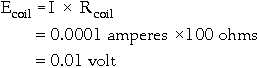
Since the coil resistance is 100 ohms, you can calculate the coil's voltage (Ecoil) by using Ohm's law,
as follows:
When the pointer is deflected to full scale, 100 microamperes of current flows through the coil and
0.01 volt drops across it. Remember, 100 microamperes is the maximum safe current for this meter
movement. Exceeding this value will damage the meter. The shunt must carry any additional load current.
The meter coil has a 0.01 volt drop across it, and, because the shunt and coil are in parallel, the shunt
also has a voltage drop of 0.01 volt. The current that flows through the shunt is the difference between the
full-scale meter current and the line current being fed into the shunt. In this case, meter current is 100
microamperes. Full-scale deflection is desired only when the total current is 1 ampere. Therefore, the
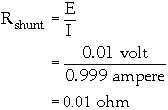
shunt current must equal 1 ampere minus 100 microamperes, or 0.9999 ampere. Ohm's law is again used
to provide the approximate value of required shunt resistance (Rshunt), as follows: