2-21
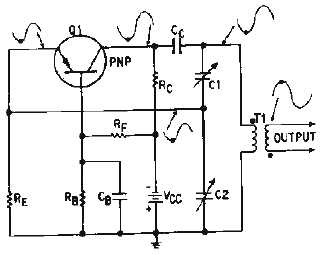
Figure 2-16.—Common-base Colpitts oscillator.
Q-14. What is the identifying feature of a Colpitts oscillator?
RESISTIVE-CAPACITIVE (RC) FEEDBACK OSCILLATOR
As mentioned earlier, resistive-capacitive (RC) networks provide regenerative feedback and
determine the frequency of operation in RESISTIVE-CAPACITIVE (RC) OSCILLATORS.
The oscillators presented in this chapter have used resonant tank circuits (LC). You should already
know how the LC tank circuit stores energy alternately in the inductor and capacitor.
The major difference between the LC and RC oscillator is that the frequency-determining device in
the RC oscillator is not a tank circuit. Remember, the LC oscillator can operate with class A or C biasing
because of the oscillator action of the resonant tank. The RC oscillator, however, must use class A biasing
because the RC frequency-determining device doesn't have the oscillating ability of a tank circuit.
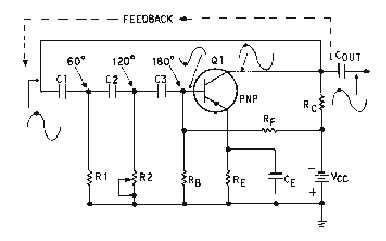
An RC FEEDBACK or PHASE-SHIFT oscillator is shown in figure 2-17. Components C1, R1, C2,
R2, C3, and RB are the feedback and frequency-determining network. This RC network also provides the
needed phase shift between the collector and base.
Figure 2-17.—Phase-shift oscillator.