1-30
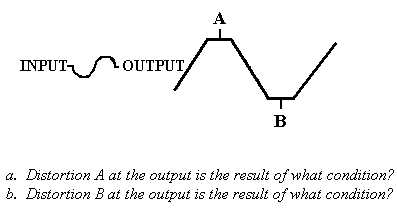
Q20.
The waveforms shown below are the input and output of an overdriven triode.
TYPES OF BIASING
There are two main classes of biasing—FIXED and SELF. In a tube circuit that uses fixed bias, the
grid-bias voltage is supplied from a power source external to the circuit. You are already familiar with
battery bias, which is one form of fixed bias. When fixed bias is used in a circuit, it can be represented as
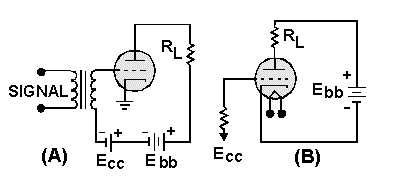
either a battery (fig. 1-21, view A), or as a conductor connected to -Ecc (fig. 1-21, view B). Fixed bias is
rarely used in electronics today. Therefore, we will not discuss it further.
Figure 1-21.—Fixed bias: A. Battery B. Conductor
In circuits using self-bias, the bias voltage is developed across a resistor in the cathode or grid circuit
by tube current. There are two main methods of self-bias: cathode biasing and grid-leak biasing.
Cathode Bias
In circuits using cathode bias, the cathode is made to go positive relative to the grid. The effect of
this is the same as making the grid negative relative to the cathode. Because the biasing resistor is in the
cathode leg of the circuit, the method is called CATHODE BIASING or CATHODE BIAS. A triode
circuit using cathode bias is shown in figure 1-22.