1-4
and extremely important. Practically everything that follows will be related in some way to the Edison
effect. Be sure you have a good understanding of it before you go on.
Q1.
How can a sheet of copper be made to emit electrons thermionically?
Q2.
Why do electrons cross the gap in a vacuum tube?
THE DIODE TUBE
The diode vacuum tube we are about to study is really Edison’s old incandescent bulb with the plate
in it. Diode means two elements or two electrodes, and refers to the two parts within the glass container
that make up the tube. We have called them filament and plate. More formally, they are called
CATHODE and PLATE, respectively. Sometimes the filament is called a HEATER, for obvious
reasons-more on this later.
Within a few years after the discovery of the Edison effect, scientists had learned a great deal more
than Edison knew at the time of his discovery. By the early 1900s, J.J. Thomson in England had
discovered the electron. Marconi, in Italy and England, had demonstrated the wireless, which was to
become the radio. The theoretical knowledge of the nature of electricity and things electrical was
increasing at a rapid rate.
J.A. Fleming, an English scientist, was trying to improve on Marconi’s relatively crude wireless
receiver when his mind went back to Edison’s earlier work. His subsequent experiments resulted in what
became known as the FLEMING VALVE (the diode), the first major step on the way to electronics.
OPERATION OF THE DIODE TUBE
Before learning about Fleming’s valve, the forerunner of the modern diode, let’s look at Edison’s
original circuit. This time, however, we’ll draw it as a schematic diagram, using the symbol for a diode
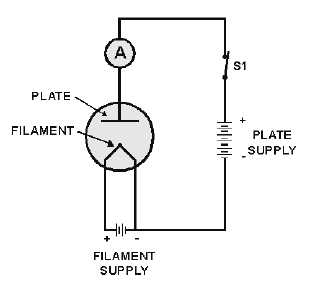
instead of a cartoon-like picture. The schematic is shown in figure 1-3.
Figure 1-3.—Schematic of Edison's experimental circuit.
Note that this is really two series circuits. The filament battery and the filament itself form a series
circuit. This circuit is known as the filament circuit.