1
ASSIGNMENT 1
Textbook Assignment: Chapter 1, “Electrical Conductors,” pages 1-1 through 1-27.
Chapter 2 “Wiring Techniques,” pages 2-1 through 2-23.
_________________________________________________________________________________
1-1. Why has a "unit size" for conductors
been established?
1. To compare the size and resistance of
one conductor with that of another
2. To establish a uniform style for
conductors
3. To determine the requirements for
conductors
4. To ensure all conductors are
interchangeable
1-2. What is the decimal equivalent of one (1)
mil?
1. 1.000 in.
2. 0.100 in.
3. 0.010 in.
4. 0.001 in.
1-3. If a conductor has a diameter of 1/4 inch,
what is its diameter in mils?
1.
250.0 mil
2.
25.0 mil
3.
2.50 mil
4.
0.250 mil
1-4. What is the definition of a mil foot?
1.
A conductor .001 foot in length with
a diameter of .001 millimeter
2.
A conductor 1 foot in length with a
diameter of .001 foot
3.
A conductor 1 foot in length with a
diameter of 1 mil
4.
A conductor .001 foot in length with
a diameter of .001 inch
1-5. A square mil is defined as the area of a
square, the sides of which are each equal
in length to what dimension?
1. 1 mil-foot
2. 1 mil
3. 1.0 inch
4. .001 mil
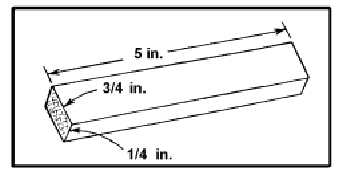
Figure 1A.—Rectangular Bar Conductor.
IN ANSWERING QUESTION 1-6, REFER TO
FIGURE 1A.
1-6. What is the cross-section area of the
illustrated rectangular bar conductor in
square mils?
1. 937,500,000 sq. mil
2. 3,750,000 sq. mil
3. 1,250,000 sq. mil
4. 187,500 sq. mil
1-7. A circular mil is defined as the area of a
circle having what dimension?
1. A radius of 1 mil
2. A diameter of 1 mil
3. A circumference of 1 mil
4. A chord of 1 mil