1-10
ideally suited for locating shorted or opened printed-circuit-board runs, wires, or components. In the
absence of a suitable pulsing current to drive the current tracer, a logic pulser or pulse generator may be
used as a signal source. The inherent disadvantage of a current tracer is that it requires an external power
supply. They can, however, be connected to the power supply of the equipment under test if the voltage is
correct.
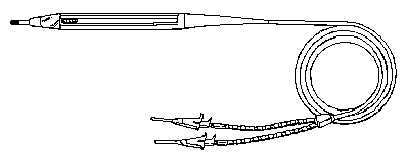
Figure 1-7.—Current tracer.
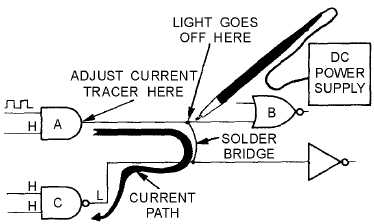
Figure 1-8.—Current tracer application.
CURRENT PROBES
Current probes, as shown in figure 1-9, are primarily designed to be used with an oscilloscope or
milliammeter for measuring current. Although not used very often by Navy technicians, current probes
are available. The primary advantage in using a current probe is that it does not need to be in series with
the current being measured. Unsoldering wires or connections to terminals is not necessary; current
probes are designed to be clamped onto insulated conductors. They are able to sense, through inductive
action, the magnitude of the current flowing in the conductor. Current probes are designed for performing
small ac current measurements. Also, when you use them in conjunction with current probe amplifiers,
the capabilities of the current probe are extended to measurement of both ac and dc currents with large
magnitudes. Current probes are extremely useful when you measure the current drain on a power supply,
start-up current of a motor, or current flow in relays. These probes can be divided into three basic types:
passive, active, and Hall effect. Each type has advantages and disadvantages peculiar to its method of
operation. Prior to using a current probe, you should thoroughly understand its instructions.