3-33
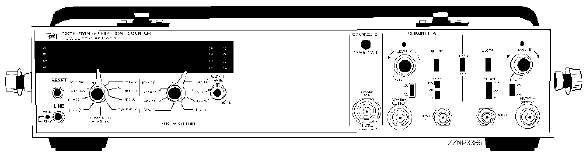
Figure 3-25.—Frequency counter.
RADIO-FREQUENCY (RF) MEASUREMENTS
Radio-frequency measurements are primarily made with frequency counters. Most oscilloscopes are
limited in use to approximately 100 MHz. Frequency meters, such as the Hewlett-Packard 530 series, are
widely used but lack the accuracy of frequency counters.
Frequency Meters
Prior to the invention of the frequency counter, most frequency measurements above the af range
were made primarily with frequency meters.
This process involved heterodyning the frequency to be measured against the calibrated output of the
frequency meter to obtain a zero beat from which the measured frequency was then read. This method
proved inaccurate because of reading errors.
Frequency meters as we know them today are entirely different from their predecessors. Today's
frequency meters (fig. 3-26) contain waveguide or coaxial lines coupled to quarter-wavelength resonant
cavities. The meter is adjusted until the cavity is tuned to the resonant frequency of the signal being
measured. At resonance, power is absorbed by the cavity and produces a dip in the output-power level, as
measured at the frequency meter's output connector. The resonant frequency is read directly from the
frequency meter dial and is accurate, in most cases, to approximately
0.2%. Frequency meters are
capable of measuring frequencies in the range of 1 to 40 gigahertz, far exceeding the frequency
limitations of the average frequency counter.
Q-20.
What happens when a frequency meter is adjusted to the frequency of the signal being
measured?