1-38
follow a beam of radar energy that is kept continuously pointed at the desired target; (2) homing missiles
detect and home in on radar energy reflected from the target; the reflected energy is provided by a radar
transmitter either in the missile or at the launch point and is detected by a receiver in the missile; (3)
passive homing missiles home in on energy that is radiated by the target. Because target position must be
known at all times, a guidance radar is generally part of, or associated with, a fire-control tracking radar.
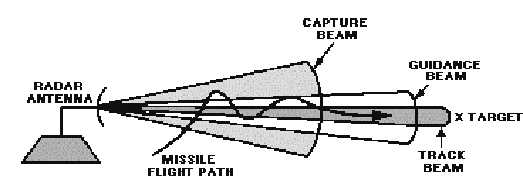
In some instances, three radar beams are required to provide complete guidance for a missile. The beam-
riding missile, for example, must be launched into the beam and then must ride the beam to the target.
Initially, a wide beam is radiated by a capture radar to gain (capture) control of the missile. After the
missile enters the capture beam, a narrow beam is radiated by a guidance radar to guide the missile to the
target. During both capture and guidance operations, a tracking radar continues to track the target. Figure
1-29 illustrates the relationships of the three different radar beams.
Figure 1-29.—Beam relationship of capture, guidance, and track beams.
Q41. Fire-control tracking radar most often radiates what type of beam?
Q42. Tracking radar searches a small volume of space during which phase of operation?
Q43. What width is the pulse radiated by fire-control tracking radar?
Q44. Which beam of missile-guidance radar is very wide?
CARRIER-CONTROLLED APPROACH (CCA) AND GROUND-CONTROLLED APPROACH
(GCA) RADAR
CARRIER-CONTROLLED APPROACH and GROUND-CONTROLLED APPROACH radar
systems are essentially shipboard and land-based versions of the same type of radar. Shipboard CCA
radar systems are usually much more sophisticated systems than GCA systems. This is because of the
movements of the ship and the more complicated landing problems. Both systems, however, guide
aircraft to safe landing under conditions approaching zero visibility. By means of radar, aircraft are
detected and observed during the final approach and landing sequence. Guidance information is supplied
to the pilot in the form of verbal radio instructions, or to the automatic pilot (autopilot) in the form of
pulsed control signals.
AIRBORNE RADAR
Airborne radar is designed especially to meet the strict space and weight limitations that are
necessary for all airborne equipment. Even so, airborne radar sets develop the same peak power as
shipboard and shore-based sets.