1-15
RADAR ACCURACY
Radar accuracy is a measure of the ability of a radar system to determine the correct range, bearing,
and, in some cases, height of an object. The degree of accuracy is primarily determined by the resolution
of the radar system. Some additional factors affecting accuracy are pulse shape and atmospheric
conditions.
Pulse Shape
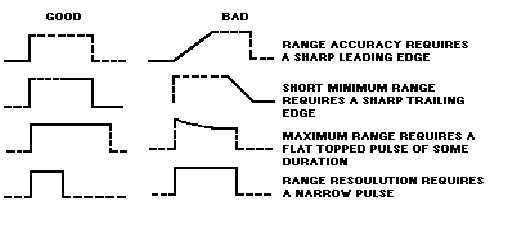
In the case of a pulse radar, the shape and width of the rf pulse influences minimum range, range
accuracy, and maximum range. The ideal pulse shape is a square wave having vertical leading and trailing
edges. However, equipments do not usually produce the ideal waveforms.
The factors influencing minimum range are discussed first. Since the receiver cannot receive target
reflections while the transmitter is operating, you should be able to see that a narrow pulse is necessary
for short ranges. A sloping trailing edge extends the width of the transmitter pulse, although it may add
very little to the total power generated. Therefore, along with a narrow pulse, the trailing edge should be
as near vertical as possible.
A sloping leading edge also affects minimum range as well as range accuracy since it provides no
definite point from which to measure elapsed time on the indicator time base. Using a starting point at the
lower edge of the pulse’s leading edge would increase minimum range. Using a starting point high up on
the slope would reduce the accuracy of range measurements at short ranges which are so vital for accurate
solution of the fire-control problem.
Maximum range is influenced by pulse width and pulse repetition frequency (prf). Since a target can
reflect only a very small part of the transmitted power, the greater the transmitted power, the greater the
strength of the echo that could be received. Thus, a transmitted pulse should quickly rise to its maximum
amplitude, remain at this amplitude for the duration of the desired pulse width, and decay instantaneously
to zero. Figure 1-12 illustrates the effects of pulse shapes.
Figure 1-12.—Pulse shapes and effects.
Atmospheric Conditions
Electromagnetic wavefronts travel through empty space in straight lines at the speed of light, but the
REFRACTIVE INDEX of the atmosphere affects both the travel path and the speed of the