1-2
BASIC RADAR CONCEPTS
The electronics principle on which radar operates is very similar to the principle of sound-wave
reflection. If you shout in the direction of a sound-reflecting object (like a rocky canyon or cave), you will
hear an echo. If you know the speed of sound in air, you can then estimate the distance and general
direction of the object. The time required for a return echo can be roughly converted to distance if the
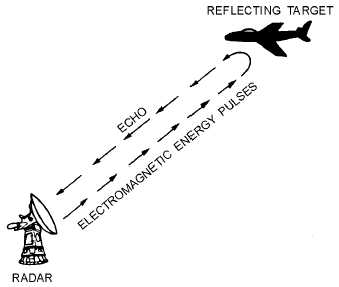
speed of sound is known. Radar uses electromagnetic energy pulses in much the same way, as shown in
figure 1-1. The radio-frequency (rf) energy is transmitted to and reflects from the reflecting object. A
small portion of the energy is reflected and returns to the radar set. This returned energy is called an
ECHO, just as it is in sound terminology. Radar sets use the echo to determine the direction and distance
of the reflecting object.
Figure 1-1.—Radar echo.
NOTE: The terms TARGET, RETURN, ECHO, CONTACT, OBJECT, and REFLECTING
OBJECT are used interchangeably throughout this module to indicate a surface or airborne object that has
been detected by a radar system.
Radar systems also have some characteristics in common with telescopes. Both provide only a
limited field of view and require reference coordinate systems to define the positions of detected objects.
If you describe the location of an object as you see it through a telescope, you will most likely refer to
prominent features of the landscape. Radar requires a more precise reference system. Radar surface
angular measurements are normally made in a clockwise direction from TRUE NORTH, as shown in
figure 1-2, or from the heading line of a ship or aircraft. The surface of the earth is represented by an
imaginary flat plane, tangent (or parallel) to the earth’s surface at that location. This plane is referred to as
the HORIZONTAL PLANE. All angles in the up direction are measured in a second imaginary plane that
is perpendicular to the horizontal plane.