4-7
As early as June 1960, two satellites were successfully placed in orbit by the same launch vehicle.
With the development of multilaunch capability, added flexibility became available. We then had choices
as to the size, weight, and number of satellites to be included in each launch.
Using our multilaunch capabilities, the Defense Satellite Communications System (DSCS) has
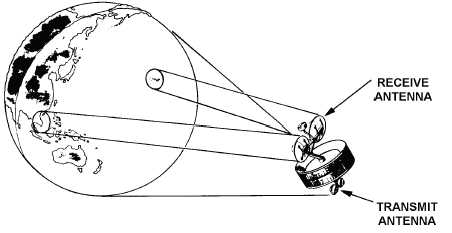
placed larger and heavier satellites in synchronous equatorial orbits. Figure 4-7 is a drawing of a DSCS
satellite. It shows each pair of transmit and receive dish antennas. As you can see, a large area of the earth
can be covered using only one satellite.
Figure 4-7.—DSCS satellite.
Satellite Power Sources
Early communications satellites were severely limited by the lack of suitable power sources. This
severely limited the output power of the satellite transmitter. The only source of power available within
early weight restrictions was a very inefficient panel of solar cells without battery backup. A major
disadvantage of this type of power source is that the satellite has no power when it is in ECLIPSE (not in
view of the sun). For continuous communications, this outage is unacceptable.
A combination of solar cells and storage batteries is a better prime power source. This is a practical
choice, even though the result is far from an ideal power source. About ten percent of the energy of the
sunlight that strikes the solar cells is converted to electrical power. This low rate is sometimes decreased
even further. You find this when the solar cells are bombarded by high-energy particles that are
sometimes found in space.
Early satellites had over 8,500 solar cells mounted on the surface of the satellite, which supplied
about 42 watts of power. No battery backup was provided in these satellites.
Newer communications satellites have about 32,000 solar cells mounted on the surface of the
satellite, and they supply about 520 watts. A nickel cadmium battery is used for backup power during
eclipses.
Nuclear power sources have been used in space for special purposes, but their use stops there.
Technology has not progressed sufficiently for nuclear power sources to be used as a power source.