4-6
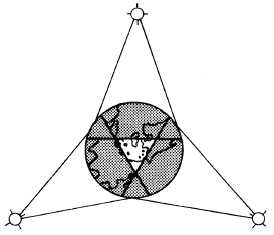
Three of these satellites can provide coverage over most of the earth (except for the extreme north
and south polar regions). A polar projection of the global coverage of a three-satellite system is shown in
figure 4-6.
Figure 4-6.—Worldwide synchronous satellite system viewed from above the North Pole.
A satellite in a circular orbit at other than 19,300 nautical miles above the earth is in a near-
synchronous orbit. If the orbit is lower than 19,300 nautical miles, the period of orbit of the satellite is
less than the period of orbit of the earth. The satellite then appears to be moving slowly around the earth
from west to east. (This type of orbit is also called subsynchronous.) If the orbit is higher than 19,300
nautical miles, the period of orbit of the satellite is greater than the period of orbit of the earth. The
satellite then appears to be moving slowly around the earth from east to west. Although inclined and polar
near-synchronous orbits are possible, near synchronous implies an equatorial orbit.
A satellite in a circular orbit from approximately 2,000 miles to 12,000 miles above the earth is
considered to be in a MEDIUM ALTITUDE ORBIT. The period of a medium altitude satellite is
considerably less than that of the earth. When you look at this altitude satellite, it appears to move rather
quickly across the sky from west to east.
Q1. What are the two types of communications satellites?
Q2. A typical satellite communications operational link consists of a satellite and what two other
components?
Q3. A satellite in a synchronous orbit can cover how much of the surface of the earth?
Q4. What areas of the earth are not normally covered by satellites?
SATELLITE CHARACTERISTICS
Early communications satellites were limited in size to the diameter of the final stage of the rocket
that was used for launching. Weight was determined by the thrust of the rocket motors and the maximum
weight the rocket could lift into orbit.