6-35
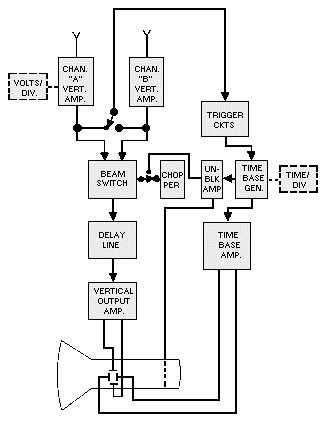
Figure 6-39.—Basic dual-trace oscilloscope block diagram.
ACCESSORIES
The basic dual-trace oscilloscope has one gun assembly and two vertical channels. However, there
are many variations. The horizontal sweep channels vary somewhat from equipment to equipment. Some
have one time-base circuit and others have two. These two are interdependent in some oscilloscopes and
in others they are independently controlled. Also, most modern general-purpose oscilloscopes are
constructed of modules. That is, most of the vertical circuitry is contained in a removable plug-in unit,
and most of the horizontal circuitry is contained in another plug-in unit.
The main frame of the oscilloscope is often adapted for many other special applications by the
design of a variety of plug-in assemblies. This modular feature provides much greater versatility than in a
single-trace oscilloscope. For instance, to analyze the characteristics of a transistor, you can replace the
dual-trace, plug-in module with a semiconductor curve-tracer plug-in module.
Other plug-in modules available with some oscilloscopes are high-gain, wide-bandwidth amplifiers;
differential amplifiers; spectrum analyzers; physiological monitors; and other specialized units. Therefore,
the dual-trace capability is a function of the type of plug-in unit that is used with some oscilloscopes.
To get maximum usefulness from an oscilloscope, you must have a means of connecting the desired
signal to the oscilloscope input. Aside from cable connections between any equipment output and the
oscilloscope input, a variety of probes are available to assist in monitoring signals at almost any point in a
circuit. The more common types include 1-TO-1 PROBES, ATTENUATION PROBES, and CURRENT
PROBES. Each of these probes may be supplied with several different tips to allow measurement of
signals on any type of test point. Figure 6-40 shows some of the more common probe tips.