1-54
Binary to Decimal
The computer that calculates your pay probably operates with binary numbers, so a conversion takes
place in the computer before the amount is printed on your check. Some computers, however, don’t
automatically convert from binary to decimal. There may be times when you must convert
mathematically.
To convert a base 2 number to base 10, you must know the decimal equivalent of each power of 2.
The decimal value of a power of 2 is obtained by multiplying 2 by itself the number of times indicated by
the exponent for whole numbers; for example, 24 = 2 2 2 2 or 1610.
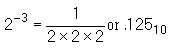
For fractional numbers, the decimal value is equal to 1 divided by 2 multiplied by itself the number
of times indicated by the exponent. Look at this example:
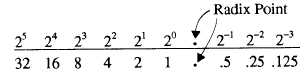
The table below shows a portion of the positions and decimal values of the binary system:
Remember, earlier in this chapter you learned that any number to the 0 power is equal to 110.
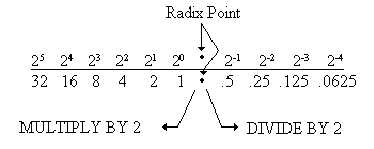
Another method of determining the decimal value of a position is to multiply the preceding value by
2 for whole numbers and to divide the preceding value by 2 for fractional numbers, as shown below:
Let’s convert a binary number to decimal by using the positional notation method. First, write out the
number to be converted; then, write in the decimal equivalent for each position with a 1 indicated. Add
these values to determine the decimal equivalent of the binary number. Look at our example: