1-48
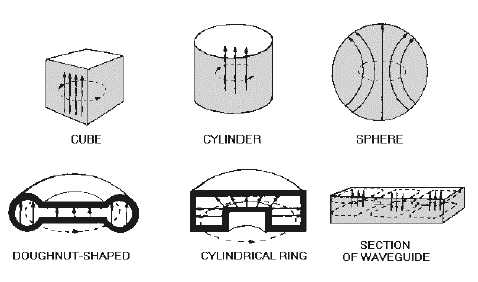
Figure 1-60.—Several types of cavities.
Cavity resonators are energized in basically the same manner as waveguides and have a similar field
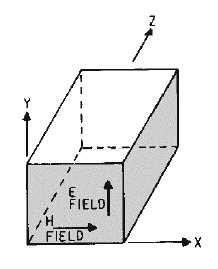
distribution. If the cavity shown in figure 1-61 were energized in the TE mode, the electromagnetic wave
would reflect back and forth along the Z axis and form standing waves. These standing waves would form
a field configuration within the cavity that would have to satisfy the same boundary conditions as those in
a waveguide. Modes of operation in the cavity are described in terms of the fields that exist in the X, Y,
and Z dimensions. Three subscripts are used; the first subscript indicates the number of 1/2! along the X
axis; the second subscript indicates the number of 1/2! along the Y axis; and the third subscript indicates
the number of 1/2! along the Z axis.
Figure 1-61.—Rectangular cavity resonator.
Energy can be inserted or removed from a cavity by the same methods that are used to couple energy
into and out of waveguides. The operating principles of probes, loops, and slots are the same whether
used in a cavity or a waveguide. Therefore, any of the three methods can be used with cavities to inject or
remove energy.