2-24
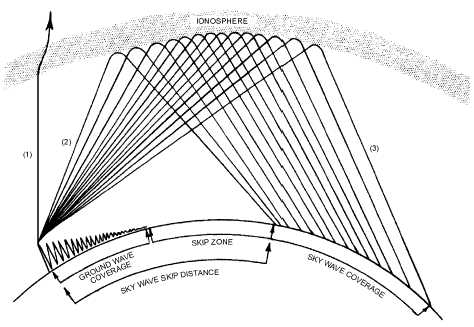
Skip Distance/Skip Zone
In figure 2-19, note the relationship between the sky wave skip distance, the skip zone, and the
ground wave coverage. The SKIP DISTANCE is the distance from the transmitter to the point where the
sky wave is first returned to Earth. The size of the skip distance depends on the frequency of the wave, the
angle of incidence, and the degree of ionization present.
Figure 2-19.—Relationship between skip zone, skip distance, and ground wave.
The SKIP ZONE is a zone of silence between the point where the ground wave becomes too weak
for reception and the point where the sky wave is first returned to Earth. The size of the skip zone
depends on the extent of the ground wave coverage and the skip distance. When the ground wave
coverage is great enough or the skip distance is short enough that no zone of silence occurs, there is no
skip zone.
Occasionally, the first sky wave will return to Earth within the range of the ground wave. If the sky
wave and ground wave are nearly of equal intensity, the sky wave alternately reinforces and cancels the
ground wave, causing severe fading. This is caused by the phase difference between the two waves, a
result of the longer path traveled by the sky wave.
PROPAGATION PATHS
The path that a refracted wave follows to the receiver depends on the angle at which the wave strikes
the ionosphere. You should remember, however, that the rf energy radiated by a transmitting antenna
spreads out with distance. The energy therefore strikes the ionosphere at many different angles rather than
a single angle.
After the rf energy of a given frequency enters an ionospheric region, the paths that this energy
might follow are many. It may reach the receiving antenna via two or more paths through a single layer. It