2-15
equator. Virtually all weather phenomena take place in the troposphere. The temperature in this region
decreases rapidly with altitude, clouds form, and there may be much turbulence because of variations in
temperature, density, and pressure. These conditions have a great effect on the propagation of radio
waves, which will be explained later in this chapter.
STRATOSPHERE
The stratosphere is located between the troposphere and the ionosphere. The temperature throughout
this region is considered to be almost constant and there is little water vapor present. The stratosphere has
relatively little effect on radio waves because it is a relatively calm region with little or no temperature
changes.
IONOSPHERE
The ionosphere extends upward from about 31.1 miles (50 km) to a height of about 250 miles (402
km). It contains four cloud-like layers of electrically charged ions, which enable radio waves to be
propagated to great distances around the Earth. This is the most important region of the atmosphere for
long distance point-to-point communications. This region will be discussed in detail a little later in this
chapter.
Q11. What are the three layers of the atmosphere?
Q12. Which layer of the atmosphere has relatively little effect on radio waves?
RADIO WAVE TRANSMISSION
There are two principal ways in which electromagnetic (radio) energy travels from a transmitting
antenna to a receiving antenna. One way is by GROUND WAVES and the other is by SKY WAVES.
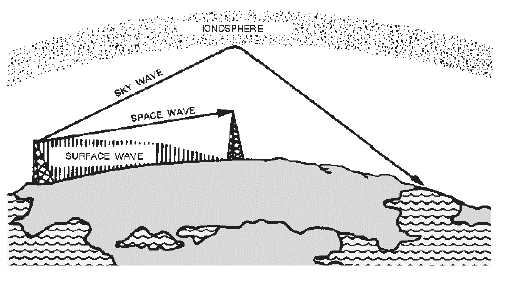
Ground waves are radio waves that travel near the surface of the Earth (surface and space waves). Sky
waves are radio waves that are reflected back to Earth from the ionosphere. (See figure 2-11.)
Figure 2-11.—Ground waves and sky waves.