1-42
The LONGITUDINAL WAVE is another type of wave motion. The sound wave is the only
example of a longitudinal wave given in this text.
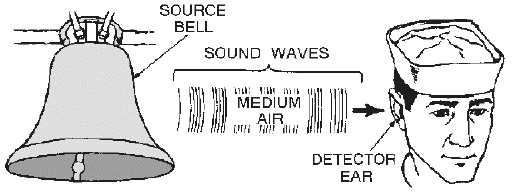
SOURCE, MEDIUM, AND DETECTOR (RECEIVER) are the three requirements for all wave
motion.
A SOURCE can be anything that emits or expends energy (waves).
The MEDIUM is the vehicle for carrying waves from one point to another. Water, air, metal, empty
space, etc., are examples of a medium. Empty space is considered a medium for electro-magnetic waves
but not a medium for sound waves.
The SOUND DETECTOR absorbs the waves emitted by the source. The human ear is an example
of a detector.
HERTZ, which is abbreviated Hz, is used in lieu of "cycle per second" when referring to radio
frequencies.
VELOCITY OF PROPAGATION is the speed (or rate) at which the crest of a wave moves
through a medium. Velocity can be calculated by using the formula:
9 I
:KHUH Y LV YHORFLW\ RI SURSDJDWLRQ DQG LV H[SUHVVHG LQ IHHW PHWHUV SHU VHFRQG LV WKH ZDYHOHQJWK
in feet (meters), and f is the frequency in hertz.
REFLECTION occurs when a wave strikes an object and bounces back (toward the source). The
wave that moves from the source to the object is called the INCIDENT WAVE, and the wave that moves
away from the object is called the REFLECTED WAVE.