4-6
1. A current flows in the antenna with an amplitude that varies with the generator voltage.
2. A sinusoidal distribution of charge exists on the antenna. Every 1/2 cycle, the charges reverse
polarity.
3. The sinusoidal variation in charge magnitude lags the sinusoidal variation in current by 1/4 cycle.
Q1. What are the two basic classifications of antennas?
Q2. What are the three parts of a complete antenna system?
Q3. What three factors determine the type, size, and shape of an antenna?
RADIATION OF ELECTROMAGNETIC ENERGY
The electromagnetic radiation from an antenna is made up of two components, the E field and the H
field. We discussed these fields in chapters 1 and 2. The two fields occur 90 degrees out of phase with
each other. These fields add and produce a single electromagnetic field. The total energy in the radiated
wave remains constant in space except for some absorption of energy by the Earth. However, as the wave
advances, the energy spreads out over a greater area and, at any given point, decreases as the distance
increases.
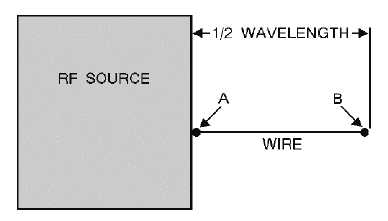
Various factors in the antenna circuit affect the radiation of these waves. In figure 4-5, for example,
if an alternating current is applied at the A end of the length of wire from A to B, the wave will travel
along the wire until it reaches the B end. Since the B end is free, an open circuit exists and the wave
cannot travel farther. This is a point of high impedance. The wave bounces back (reflects) from this point
of high impedance and travels toward the starting point, where it is again reflected. The energy of the
wave would be gradually dissipated by the resistance of the wire of this back-and-forth motion
(oscillation); however, each time it reaches the starting point, the wave is reinforced by an amount
sufficient to replace the energy lost. This results in continuous oscillations of energy along the wire and a
high voltage at the A end of the wire. These oscillations are applied to the antenna at a rate equal to the
frequency of the rf voltage.
Figure 4-5.—Antenna and rf source.
These impulses must be properly timed to sustain oscillations in the antenna. The rate at which the
waves travel along the wire is constant at approximately 300,000,000 meters per second. The length of