1-39
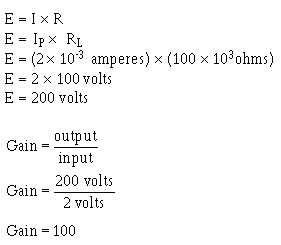
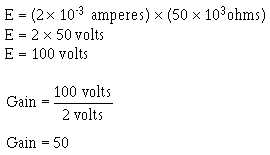
Thus, the gain of the circuit is 100. If the plate-load resistor is reduced to 50 kohms and the input is
kept at +2 volts, the gain will be reduced to:
As you can see, voltage gain depends on both the tube characteristics and the external circuit design.
The voltage gain is a measure of circuit efficiency, not tube efficiency.
The actual characteristics of a tube are measured by two factors: mu(µ) or AMPLIFICATION
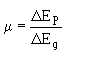
FACTOR; and TRANSCONDUCTANCE or gm. The amplification factor (represented as µ) of a tube is
equal to the ratio of a change in plate voltage to the change in grid voltage required to cause the same
change in plate current. This is expressed mathematically as
While this may sound complicated, it really isn't. Look at figure 1-28. Here you see in view A a
triode with a +1 volt input signal. At this grid voltage, current through the tube is at 1 milliampere. If the
input voltage is raised to +3 volts, current through the tube increases to 2 milliamperes. The change in Eg
(¨Eg) is then 2 volts. This is shown in view B. Suppose that the grid voltage is returned to +1 volt, and the
plate voltage is increased until the ammeter in view C reads 2 milliamperes of plate current. At this point
plate voltage is measured. Plate voltage had to be increased by 100 volts (350-250) to get the same
change in plate current (1 mA). The change in plate voltages (¨Ep) is then 100 volts. The amplification
IDFWRU
RI MXVW WKH WXEH LV WKHQ HTXDO WR